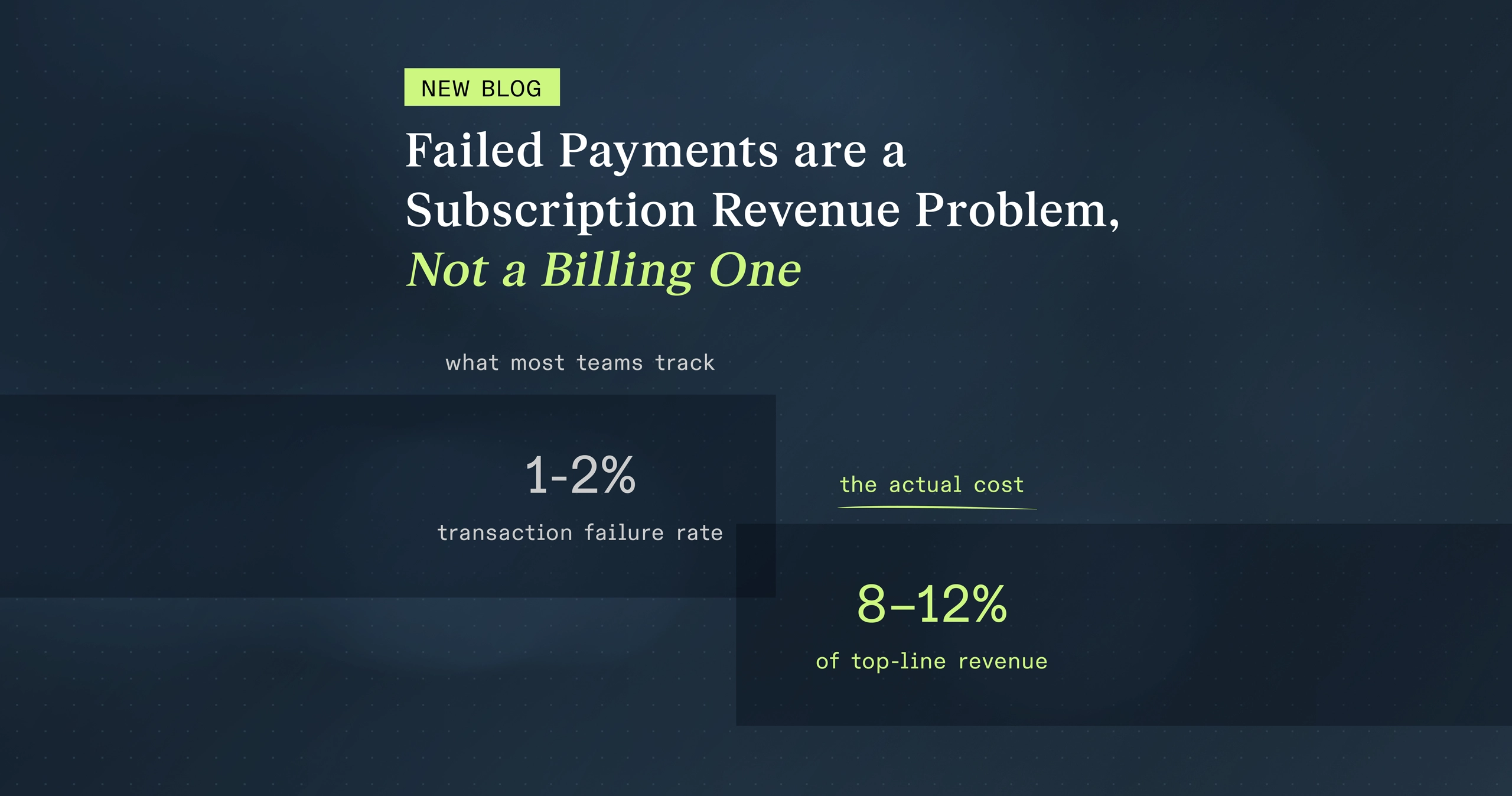
Ask a subscription business who owns failed payments, and the answer often depends on who you ask. Retention is responsible for keeping subscribers, billing manages the payment process, and finance tracks the revenue. Each has a reason to care, but none of those responsibilities necessarily includes improving what happens after a payment fails.
In more than 100 calls with subscription teams, the most common reason we heard for leaving failed payments unaddressed was unclear ownership. Teams had recovery tools in place, but reviewing their performance and making improvements had never become a clear part of anyone’s job.
That leaves retention leaders in a difficult position. They can be measured on customers lost to failed payments while having little control over the process that could keep those customers subscribed. Meanwhile, billing may have no reason to revisit a system that appears to be working as configured.
The result is a recurring loss that everyone can explain, but nobody is expected to reduce. Before another tool can help, the business needs to decide who is responsible for changing that.
Five ways ownership breaks down
This gap does not always mean there is no payments owner. Sometimes the person responsible lacks the time or authority to act. In other cases, the business has confused having a recovery process with having someone accountable for its results. Five patterns help explain how the work gets stuck.
- Orphaned: the person who set it up has left. Retry rules and customer reminders can stay in place long after the person who chose them moves on. Their replacement inherits the setup without necessarily knowing why it was chosen or when it was last reviewed. As one billing product manager put it: “It was kind of set up three years ago before I joined the team. And it just hasn’t been a priority to optimize.”
- Split: the person measured on churn cannot change the process. A retention lead can identify customers lost to failed renewals, but changing how those payments are handled requires help from billing or engineering. Without an agreed priority, the request competes with every other item on that team’s roadmap. Retention remains accountable for a result it cannot improve on its own.
- Outsourced: “the platform handles it.” A platform may retry payments and send reminders automatically. That answers who runs the process, but it leaves open who checks the results. Someone inside the business still needs to understand how much revenue remains uncollected and whether the current approach is good enough.
- Overloaded: the owner has too many other priorities. The person responsible may also manage integrations, billing changes and urgent customer issues. Failed payments keep losing out to work with a deadline or an immediate operational consequence. A steady level of loss can go unexamined because it never looks urgent enough to displace something else.
- Committee: everyone has a say, but nobody can decide. Finance, retention, billing and customer experience all have legitimate interests in the recovery process. They may disagree about when to contact a customer or how long to keep a subscription active after a payment fails. Without someone authorized to resolve those decisions, discussion can continue while the existing process stays in place.
These patterns have the same consequence: the business keeps using its current setup without deciding whether the results are acceptable. Over time, the losses become part of what everyone expects.
Related reading: Most Subscription Businesses Aren’t Managing Failed Payments. They’re Tolerating Them.
Different metrics make the gap harder to see
That acceptance is easier to sustain when each team sees only part of the problem. Leadership may see subscriber growth without knowing how many existing customers were lost to failed payments. Billing may see no sudden change worth investigating, while finance cannot readily separate unpaid renewals from other revenue losses. The payments team may be focused on approval rates, with no shared view of what those rates mean for retention.
None of those reports, on its own, gives the business a clear reason to act. A consistent failure rate can look unremarkable even when the cumulative cost deserves attention.
A shared metric gives teams a common basis for evaluating performance. Payment Success Rate measures the share of attempted billing revenue that is collected, including payments recovered after an initial decline. It helps teams assess whether their work is translating into more revenue. Our guide, Beyond Authorization Rates, explains the measure in more detail.
For subscription teams, the impact also extends beyond the unpaid renewal. Losing the subscriber can mean losing future revenue, which strengthens the case for treating failed payments as a subscription revenue problem.
Give one person responsibility and the support to act
Clear ownership starts with naming one person accountable for improving the result. That person could sit in retention, subscriptions, billing or payments. What matters is that the responsibility includes access to the data and an agreed way to get changes prioritized across teams.
The supporting roles should be equally clear. Billing or payments assesses and implements changes to the payment process, finance validates the revenue impact, and retention evaluates what happens to subscribers. The owner brings those contributions together and makes sure agreed actions move forward. A leader should be available to resolve priorities the team cannot settle itself.
A short quarterly review gives that work a regular place on the agenda. The team can review performance, discuss what has changed and decide what to investigate or improve next. Each action needs a person responsible and a date, with unexpected deterioration prompting an earlier review.
Start with the questions your team should be able to answer
Before changing the recovery process, establish whether the business can answer four questions:
- Who is accountable for reducing losses from failed payments?
- How much revenue remains uncollected after recovery?
- When did we last review performance and act on what we found?
- Who can approve a change and get the work prioritized?
If the answers are unclear, that is where the work begins. Giving someone the responsibility, evidence and support to act makes failed payments a problem the business can manage.
Revaly’s free failed-payment analysis can help establish the size of the loss and give your team a starting point for deciding what to do about it.