Key Takeaways
- Involuntary churn — recurring donations that fail silently due to expired cards, bank declines, and fraud flags — is one of the largest unaddressed revenue leaks in nonprofit sustainer programs.
- Revaly's partnership with ROI Solutions and their Revolution CRM is recovering that revenue at scale: across 10 mutual clients, recovery rates improved by more than 13 percentage points, 50,000+ donors were retained, and more than $1 million in revenue was recovered.
- The estimated incremental donor lifetime value across those organizations exceeds $8 million, a figure that will grow significantly as organizations move past early implementation.
- Involuntary churn is an operational problem disguised as a donor engagement problem, and solving it requires infrastructure, not just better outreach.
- For nonprofits on Revolution CRM, implementation is fast and requires no workflow overhaul. Most organizations see measurable results within the first month.
Why Good Donors Disappear Without Warning
Every month, recurring donors leave sustainer programs without ever intending to.
Their credit card expired. Their bank flagged the charge. The transaction timed out. No one at the organization saw it coming, and by the time the lapse shows up in a report, the donor is already cold.
This is involuntary churn. For nonprofits with active sustainer programs, it is one of the most financially significant and least-addressed sources of recurring revenue loss.
The scale is larger than most teams realize. These donors are not disengaged. They did not choose to stop giving. The payment system failed them, and without intelligent recovery in place, that failure quietly compounds month after month.
It flies under the radar because it is invisible. There is no opt-out. No cancellation. No signal to trigger re-engagement. Just a failed transaction that becomes a lapsed donor that becomes a line item in annual churn.
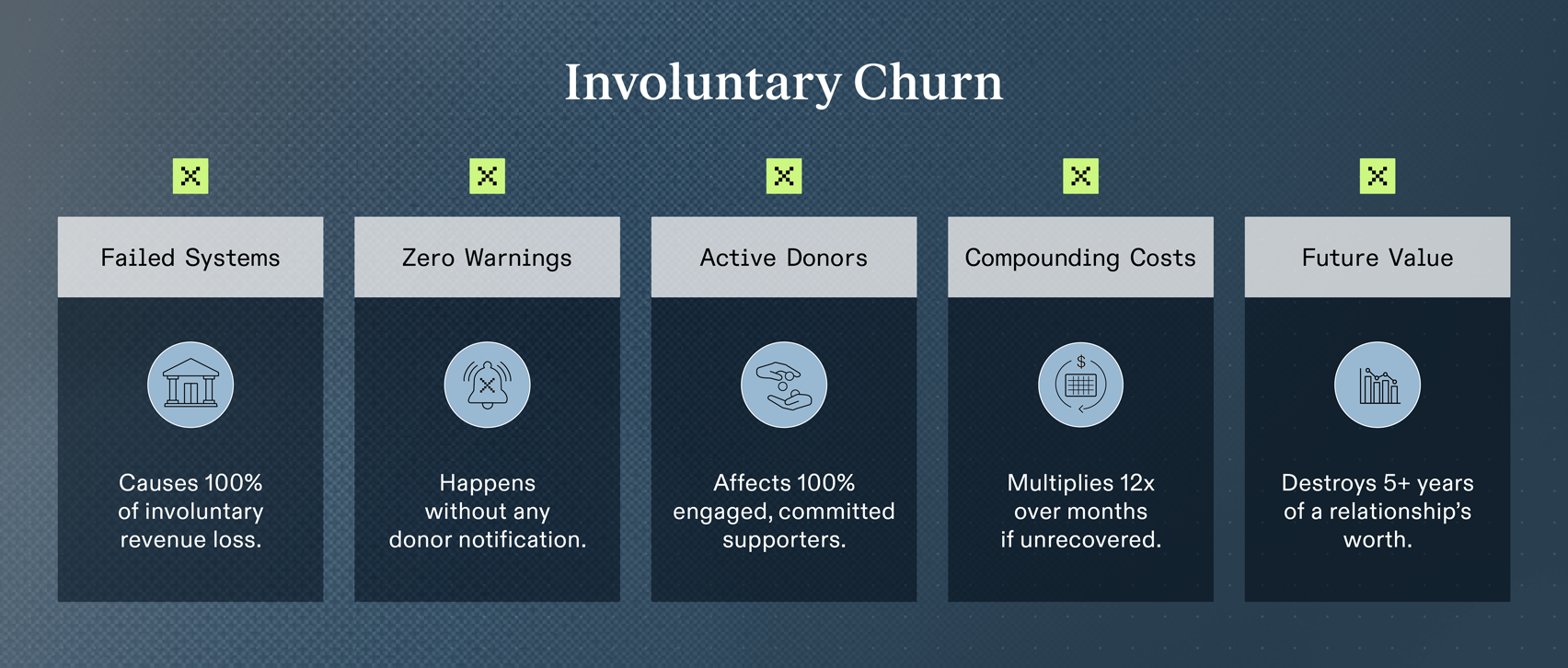
Reframe it correctly and the business case becomes impossible to ignore: a failed payment is not a billing issue. It is a lost donor relationship with years of future giving attached.
What Intelligent Payment Recovery Actually Looks Like
Revaly is a payment performance management platform built for subscription and recurring revenue businesses. We use exclusive issuer signals and machine learning to recover failed transactions before a donor ever knows there was a problem, and before the relationship has time to go cold.
Through our integration with ROI Solutions and their Revolution CRM, that capability is embedded directly into the fundraising infrastructure nonprofits already use. Donor data, recurring gift management, and payment recovery work together inside a single environment. No disconnected systems. No manual intervention. No new platforms to manage.
For a fundraising team, this means recovery happens in the background, automatically, while your team stays focused on donor stewardship and acquisition. The only thing that changes is that more of your recurring donors stay active.
The Numbers Across 10 Mutual Clients
A recent impact analysis across organizations using both Revolution CRM and Revaly found:
- Average recovery rate lift of more than 13 percentage points
- More than 50,000 recurring donors retained
- More than $1 million in recovered revenue
- Estimated incremental donor lifetime value exceeding $8 million
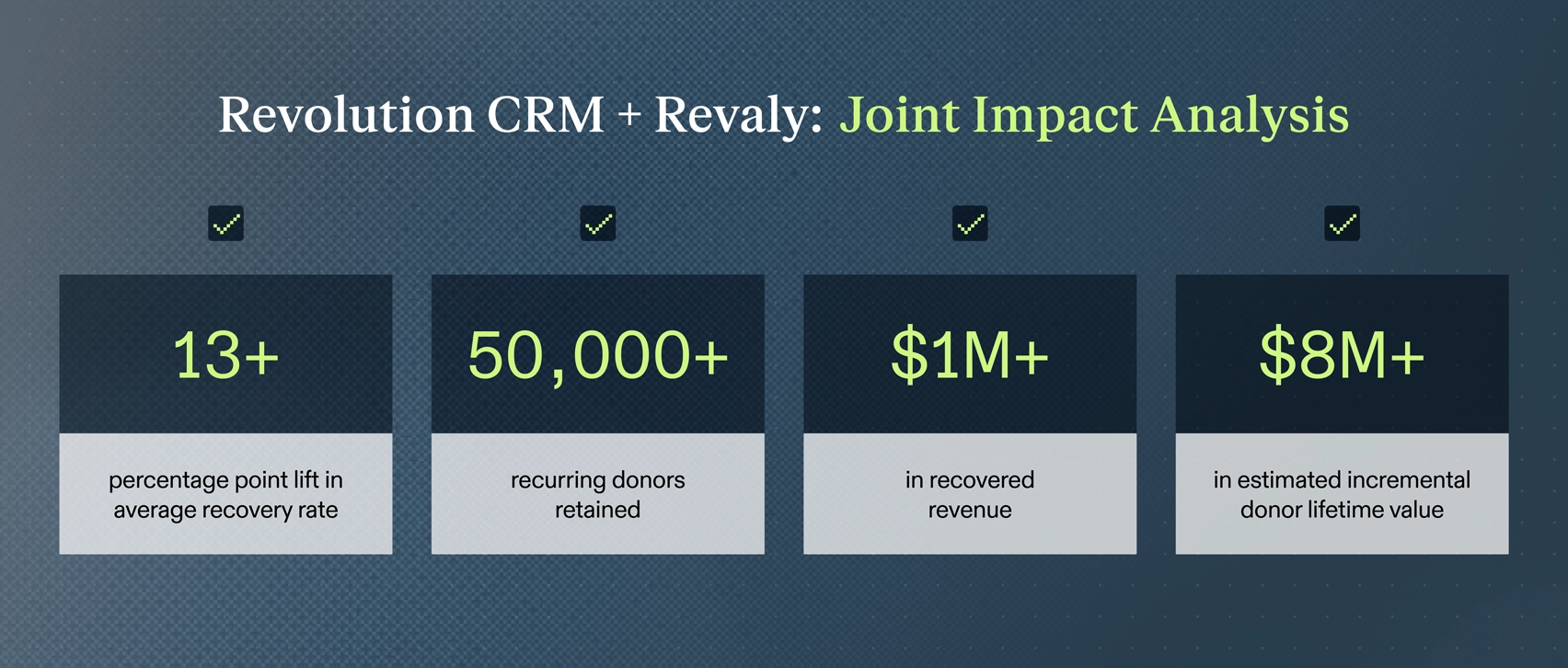
Several participating organizations were still in early-stage implementation at the time of measurement, with only two months of post-launch data included. The long-term impact will be meaningfully larger.
The client sample spanned advocacy organizations, animal welfare groups, and public media entities. That range matters because it reflects how broadly involuntary churn exists across the nonprofit sector, regardless of mission or program type.
What This Means for Your Sustainer Program
For finance, operations, and retention leaders at nonprofits, these numbers translate to a straightforward value equation: recovered payments mean retained donors, which means protected lifetime value.
A donor retained through intelligent payment recovery is not just one transaction saved. It is the full future value of that relationship preserved. Aggregate that across hundreds or thousands of sustainer donors and the financial impact is substantial, most of it incremental to what your team is already doing.
Most sustainer programs are already investing in acquisition, stewardship, and engagement. Payment recovery sits alongside that work, not in competition with it. It protects the revenue those investments create.
Fast to Deploy. Aligned to Your Outcomes.
Two questions come up consistently when nonprofits evaluate new technology partners: how long will this take, and what happens if it does not deliver?
On speed: organizations using Revolution CRM can have Revaly active within their existing environment without process disruption or lengthy timelines. Most see measurable improvements within the first full month after launch.
On risk: Revaly operates on a performance-based model. You pay based on recovered revenue. If recovery does not happen, you do not pay. That structure eliminates the financial risk of adoption entirely, which matters when you are managing a mission-driven budget with high accountability standards.
The Operational Case for Making This a Priority
Nonprofits have spent years investing in donor engagement: better storytelling, more personalized journeys, stronger stewardship at every stage. That work is essential and should continue.
But retention is not only an engagement challenge. It is an operational one. As recurring giving becomes more central to nonprofit sustainability, the systems running in the background deserve the same strategic attention as the programs they support. Whether a recurring gift processes successfully is as much a fundraising outcome as any campaign metric.
Involuntary churn is recoverable. The revenue is there. The donors intended to give. The only question is whether the right infrastructure is in place to capture it.
Ready to see what payment recovery could mean for your sustainer program? Talk to our team →